
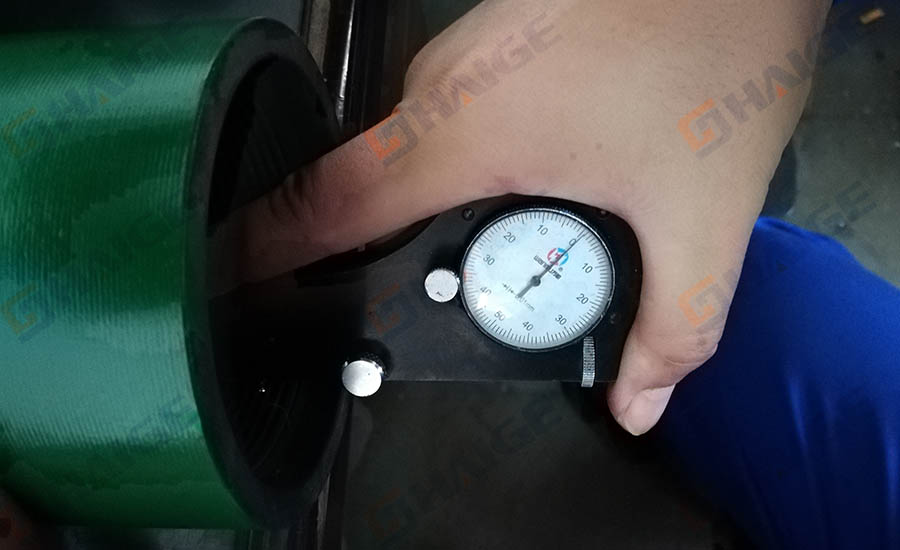
API 5CT Casing and Tubing Couplings thread inspections follow acceptance criteria set by API Spec 5CT and API Spec 5B. These standards cover threading, gauging, and inspection. Threads are accepted if they meet dimensional limits, fit the required gauges, and are free of critical defects. Otherwise, they are rejected.
The following are the main technical acceptance criteria for use as a field or QA checklist.
1. Gauge fit acceptance (API 5B)
Thread inspection relies primarily on gauges. For API 5CT couplings and pipe ends, the key acceptance rule is:
- GO gauges (thread fit measuring tools ) must fully enter and seat at the specified hand-tight or power-tight position without excessive drag or interference. (API SPEC 5B – Threading, Gauging, and Thread Inspection of Casing, Tubing, and Line Pipe
- NO-GO gauges (measuring tools that check for oversized threads)must not engage more than the allowable number of threads, typically 1 to 3 turns, and must clearly indicate “no-go” when the thread is within specification.
- L1 (external thread gauge) and L4 (internal thread gauge) thread engagementsmust be within the L1 and L4 ranges specified in API 5B for the relevant thread type.
If the thread passes the NO-GO gauge or does not achieve the required L1 or L4 engagement, the joint is rejected.
2. Dimensional and geometric limits
API 5B and 5CT specify allowable tolerances for pitch, taper, crest, root, and thread angle. Acceptance requires adherence to these tolerances.
- Pitch and tapermust be within specified tolerances to prevent the thread from binding or lurching during manufacture.
- Crest and root formsmust be full and clean. There should be no excessive rounding, undercutting, or chatter from the infeed.
- The thread run-out (end section of the thread) and lead-in (starting section)must be smooth and within the length and angle limits defined in API 5B. Abrupt or over-cut transitions are not acceptable.
Deviations that alter the contact pattern or stress distribution are considered non-conformances. Examples include non-concentric threads or incorrect taper.
3. Visual and defect limits
Visual inspection is a formal part of thread acceptance. It focuses on damage and surface defects.
- Threads must be free of nicks, burrs, gouges, and chatter marks that could restrict gauging or damage mating threads.
- Cracks, laminations (separationswithin the material), or seams in the thread or transition zone are criteria for automatic rejection. These are often checked using MPI (magnetic particle inspection), visual inspection, and NDT (non-destructive testing) methods.
- Mis-machining, such as incorrect thread type, partial threads, or severely damaged threads,is not repairable. Scrapping or re-machining to full specification is required.
Minor machining marks (small scratches or tooling grooves) that do not affect engagement or gauging may be acceptable, depending on the project’s supplemental requirements.
4. Makeup and torque behavior (where specified)
Some contracts, such as PSL-2 or SL-B, require first-article and periodic makeup tests as part of thread inspection acceptance. First-article joints must thread smoothly, achieve correct shoulder engagement, and display a stable torque-turn profile within the recommended range.
- Running tare-off or torque-to-turn profiles (graphs showing the force needed to turn the joint vs. angle turned) must not show sudden spikes or drops that indicate cross-threading, shoulder misalignment, or excessive thread load.
If the joint cannot be made up correctly with the specified torque and profile, the thread design or machined batch is typically held for review or rejection.
5. Special notes for API 5CT Couplings
For API 5CT Casing and Tubing Couplings, apply the acceptance criteria to:
- Inspect the internal coupling threadwith API 5B internal gauges. Check for smoothness and lack of tool marks.
- The external pipe threadsthat engage with the couplings must also meet API 5B gauge and visual criteria.
Any Coupling in service that fails gauging, exhibits thread defects, or cannot be made up cleanly should be removed from the string and treated as non-compliant with API 5CT. If you request a checklist or note for rig-floor inspectors, I can condense it for a field-ready criteria sheet.
References
(n.d.). API SPEC 5B – Threading, Gauging, and Thread Inspection of Casing, Tubing, and Line Pipe Threads. https://standards.globalspec.com/std/14356770/api-spec-5b
Institute, A. P. (n.d.). API SPEC 5B: Threading, Gauging, and Inspection of Casing, Tubing, and Line Pipe Threads. https://shop.standards.ie/en-ie/standards/api-5b-2017-96272_saig_api_api_201469/
(2017). API Spec 5B – Unbound PDF – Engineering & Industrial Standards. API Spec 5B. https://www.specshelf.com/standards/API-Spec-5B/
(2017). API Spec 5B – Threading, Gauging, and Inspection of Casing, Tubing, and Line Pipe Threads. API Spec 5B. https://www.specshelf.com/standards/API-Spec-5B/
Institute, A. P. (2017). API SPEC 5B-2017: Specification for Threading, Gauging, and Thread Inspection of Casing, Tubing, and Line Pipe Threads. API SPEC 5B-2017. https://www.api.org/products-and-services/standards/standards-catalog/api-spec-5b-2017
Institute, A. P. (2017). API Spec 5B: Threading, Gauging, and Inspection of Casing, Tubing, and Line Pipe Threads. API Spec 5B. https://www.api.org/products-and-services/standards/standards-catalog/api-spec-5b
(2023). API SPECIFICATION 5CT: Casing and Tubing – Eleventh Edition (2023). API SPEC 5CT. https://studylib.net/doc/27888860/api-spec-5ct-2023–2024–casing-and-tubing
(2017). API SPEC 5B: Threading, Gauging, and Thread Inspection of Casing, Tubing, and Line Pipe Threads. API SPEC 5B. https://www.skybearstandards.com/documents/api-spec-5b-threading-gauging-and-thread-inspection-of-casing-tubing-and-line-pipe-threads/
(2023). API 5CT Casing and Tubing Specification. API 5CT Casing and Tubing Specification. https://www.hncgsteel.com/2023/12/13/the-specification-governing-the-technical-requirements/
(2025). API Thread Standards – Complete Overview 2025. Plastiform. https://www.plastiform.info/en/blog/engineering/api-thread-standards-complete-overview/
(2025). API 5CT – Specification for Casing and Tubing for Oil and Gas Well Applications. Publisher: Sunlion Steel. https://www.sunlionsteel.com/info/api-5ct-specification-for-casing-and-tubing-103221449.html
#api5ctinsepction #OCTGinsepction #API5Bthread #tubingthreadinspection #Couplingeue
#API5CTcouplingsdimensions #oilpipethreadinspection #api5ctCasingcouplingsinepections #
#threadengineering #threadingoctg #OCTGgauging #N80Couplinginspection