
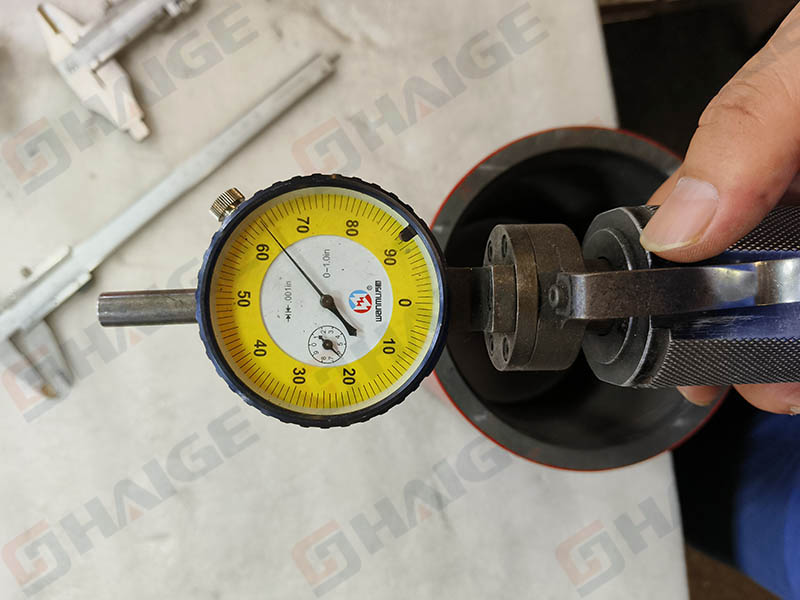
Haige J55 & L80 EUE Coupling Inspection – 2⅜” to 4½”
(API 5CT / API 5B – Field-QA Checklist)
1. Basic Identification and Grade Match
✅ Confirm markings on Coupling and Tubing:
- API monogram, grade(J55 or L80), size, EUE type, heat/lot number, and PSL level (PSL 1, 2, or 3).
✅ Check that the coupling material grade (J55 or L80) matches the tubing grade and thread type (plain EUE or grooved EUE with seal ring).
For L80 couplings:
- Make sure the L80 Couplings are quenched and tempered to meet API 5CT mechanical limits (552MPa ≈80 ksi min yield).
- Check the hardness of the L80 Couplings to ensure compliance with the API Spec. 5CT.
2. Thread Gauging (API 5B – EUE)
✅ External tubing (EUE) thread:
- API 5B GO gauge engages smoothly and seats to the correct hand-tight/power-tight position; no cross-threading or binding.
- API 5B NO-GO gauge should engage no more than 1 to 3 threads. If it engages more, reject the component.
- Verify L1 (EUE tubing)and L4 (coupling)are within the API 5B pattern for EUE tubing in that size (2⅜”, 2⅞”, 3½”, 4″, 4½”).
✅ Internal coupling (EUE box) thread:
- Internal gauge runs in smoothly, with no shoulder binding or drag.
- Thread length and relief are consistent with API 5B EUE for J55/L80. If gauging fails or L1/L4 is out of range, tag the item as Reject.
3. Visual Reject the coupling or tubing end if any of the following defects are present in the thread or relief zone:
❌ Cross-threaded or skewed thread start.
❌ Broken, chipped, or fully missing thread segment.
❌ Cracks, laminations, or seam defects in threads or relief grooves.
❌ Severe chatter marks, excessive under-cut, or over-cut, changing thread height or profile.
❌ Deep nicks, gouges, or burrs can damage matching threads or seal rings. Light machining marks may be acceptable if they do not affect gauging. Document borderline cases and obtain approval from QA or the foreman.
4. Thread Geometry and Engagement (J55 vs L80)
✅ Thread taper and threads should form a smooth, uniform helix with no visible waviness or stepped appearance.
- Thread length and shoulder distance match API 5B EUE for that size and grade.
✅ Make-up: For both J55 and L80, the shoulder must seat evenly with a stable increase in torque.torque rise.
- A sudden spike or drop in torque indicates improper thread or shoulder contact. Hold the joint for re-gauging or replacement.
5. Coupling Body and Upset Condition (J55 & L80)
✅ Coupling OD and wall thickness. There should be no visible under-sizing or thinning compared to other couplings of the same size.
- The coupling body must be free of heavy dents, kinks, or grinding marks.
✅ External upset (EUE) end:
- The upset zone should be smooth, concentric, and free of doglegs or gaps between the upset and the outer diameter.
- No cracks or separations at the upsetting transition.
✅ For grooved EUE couplings (common with L80):
- Seal ring is present, clean, undamaged, and matches the groove. The seal ring must be present, clean, undamaged, and correctly sized for the groove.
If the groove or ring is damaged, classify the item as Reject, even if the thread gauges correctly.
6. Material and Service Considerations
✅ J55 EUE couplings:
- J55 couplings are intended for moderate-pressure, low-to-medium-stress applications. Confirm the coupling is carbon steel, non-quenched, and marked J55.
- Watch fatigue-sensitive areas(thread roots, upset transitions) because repeated cycling is common in J55 production tubing strings.
✅ L80 EUE couplings:
- L80 couplings must be quenched and tempered. Verify the heat-treatment symbol or supporting documentation as required.
- For L80-9Cr and L80-13Cr sour-service variants, ensure the coupling is marked for the correct type and NACE-compatible grade.
7. Handling and Field Damage (Rig Floor)
✅ After threads and upset areas must be free from damage caused by hammering, dropping, or rough handling.g, dropping, or rough handling.
- Apply thread compound as per API RP 5A3 or project specifications. Use the correct type and coverage for J55 or L80 service.
- No visible mud, sand, or debris in threads or coupling bore.
If the coupling or tubing is visibly damaged after rig-yard handling, do not attempt to make up. Tag and remove the item.
8. Final Disposition
Accept
If the thread gauges correctly, there are no critical defects, the grade and coupling type match, and the seal ring is in good condition.
Reject or tag
- If the item fails gauging, has cracks, broken threads, heavy chatter, incorrect thread type, or a damaged seal or groove.seal/groove.
- Reject if the grade label does not match the string, such as using an L80 coupling on a J55-only design without approval.
HOLD
- For borderline defects or mismatch questions, document the issue with a photo or in a log. Get approval from QA or the foreman.
Need reliable J55 and L80 EUE Couplings that meet strict API 5CT and field QA standards?
At Haige, we supply fully traceable, inspection-ready Tubing Couplings from 2⅜” to 4½”. We offer standard Tubing Couplings, Special Clearance Couplings, and seal-ring EUE types.
Every batch is verified for material grade, thread accuracy, and field performance.
Contact us today to request specifications, inspection reports, or a fast quotation for your project.
#API5CT #API5B #EUECoupling #TubingCoupling #OilfieldEquipment #OilAndGas #DrillingEquipment #FieldInspection #QualityAssurance #ThreadGauging #TubingInspection #WellCompletion #PetroleumEquipment #IndustrialSupply #OilfieldSupplie #ChinaCouplings #API5CTCouplings #OCTG #EUECouplingstock #J55EUECouplings #gradeL80Couplings
References
Institute, A. P. (2017). API Spec 5B: Threading, Gauging, and Inspection of Casing, Tubing, and Line Pipe Threads. API Spec 5B. https://www.api.org/products-and-services/standards/standards-catalog/api-spec-5b
Institute, A. P. (2017). API Spec 5B – Specification for Threading, Gauging, and Thread Inspection of Casing, Tubing, and Line Pipe Threads. API Spec 5B. https://www.api.org/products-and-services/standards/standards-catalog/api-spec-5b
Institute, A. P. (2017). API Spec 5B: Threading, Gauging, and Inspection of Casing, Tubing, and Line Pipe Threads. API Spec 5B. https://www.api.org/products-and-services/standards/standards-catalog/api-spec-5b
(2017). API Spec 5B – Threading, Gauging, and Inspection of Casing, Tubing, and Line Pipe Threads. API Spec 5B. https://www.api.org/products-and-services/standards/standards-catalog/api-spec-5b
Institute, A. P. (n.d.). API Specification 5CT: Casing and Tubing, 11th Edition. https://www.api.org/products-and-services/standards/important-standards-announcements/standard-5ct
Institute, A. P. (2023). API Specification 5CT: Casing and Tubing. API Specification 5CT. https://www.api.org/products-and-services/standards/standards-catalog/api-specification-5ct-casing-and-tubing
(n.d.). API 5CT Casing and Tubing Specification. https://www.api.org/products-and-services/standards/standards-catalog/api-5ct-specification-casing-and-tubing
Institute, A. P. (n.d.). API Spec 5B: Threading, Gauging, and Inspection of Casing, Tubing, and Line Pipe Threads. https://www.api.org/products-and-services/standards/standards-catalog/api-spec-5b
(2017). API SPEC 5B – Threading, Gauging, and Inspection of Casing, Tubing, and Line Pipe Threads. API. https://www.api.org/products-and-services/standards/standards-catalog/api-spec-5b
Institute, A. P. (n.d.). API Spec 5B – Threading, Gauging, and Inspection of Casing, Tubing, and Line Pipe Threads. https://www.fullstandards.com/product/api-spec-5b/
(2023). API RP 5A3 – Recommended Practice on Thread Compounds for Casing, Tubing, Line Pipe, and Drill Stem Elements. API. https://standards.globalspec.com/std/14362610/api-rp-5a3