
Why Does Inspection of API 5CT L80 Casing Couplings Matter?
API 5CT casing couplings connect casing joints and keep the casing string strong and pressure-tight.
The coupling quality directly affects connection performance, installation reliability, and well integrity. Defects such as incorrect thread geometry, inadequate material control, missing heat traceability, damaged threads, or poor storage protection can lead to rejected material, installation problems, connection damage, nonproductive time, and increased operational risk.
For this reason, treat API 5CT L80 casing coupling inspection as a complete quality-control process—not simply a visual check.
A proper inspection program should review:
Purchase Requirements→ Material→ Traceability→ Dimensions→ Threads→ Gauging→
Surface Condition→ Required Testing→ Marking→ Documentation→ Packaging
API Spec 5CT establishes technical delivery requirements for casing, tubing, pup joints, coupling stock, coupling material, and accessory material. API Spec 5B addresses thread gauges, gauging practices, and thread inspection for applicable casing, tubing, and line-pipe connections.
Buyers and inspectors should always apply the specific API edition, addenda, errata, purchase order, connection requirements, and approved inspection and test plan governing the order.
What Is an API 5CT L80 Casing Coupling?
A casing coupling is a short, internally threaded component that connects two externally threaded casing joints. The coupling provides the threaded connection needed to assemble the casing string and lower it into the well.
An API 5CT L80 casing coupling is specified for use with the relevant L80 casing product and designated connection. It must meet connection and dimensional requirements. It must meet API Specification 5CT requirements for manufacturing, inspection, and marking.
What Is L80 Casing?
L80 is an API 5CT casing/tubing steel grade used in oil and gas applications. It is used where higher strength and controlled material properties are required.
Importantly, buyers should identify the specific L80 type rather than treating all L80 products as identical.
API 5CT 11th Edition recognizes L80 Type 1, L80 3Cr, and L80 13Cr under the L80 designation. The specified L80 type affects the required chemistry, heat treatment, mechanical properties, hardness, and marking. It may also affect the product’s suitability for the intended service environment. When a purchase order uses “L80” alone, it usually means the L80-1 type.
| L80 Type 1 | Conventional L80 grade designation for applicable casing and tubing requirements |
| L80 3Cr | Chromium-containing L80 grade introduced for mildly corrosive downhole environments |
| L80 9Cr | Higher-chromium L80 grade for applicable corrosion-service conditions |
| L80 13Cr | Higher-chromium L80 grade for applicable corrosion-service conditions |
API 5CT L80 Casing Coupling Inspection Checklist
Use the following checklist as a functional framework for receiving, manufacturing, or third-party inspection.
This is not a replacement for the applicable API standard, purchaser specification, or inspection and test plan (ITP).
1. Purchase Order and Specification Review
Before inspecting the physical couplings, verify the order requirements.
Check:
- Casing size
- Grade
- L80 type
- Connection/thread designation
- Coupling type
- Quantity
- Applicable API specification edition
- Purchaser specifications
- Inspection level
- NDE requirements
- Documentation criteria
- Special requirements or supplementary requirements
This first step prevents inspectors from applying the wrong acceptance criteria.
2. Material Grade Verification
Confirm that the coupling material corresponds to the specified L80 grade.
Review:
- Material certificate
- Heat number
- Chemical composition
- Mechanical properties
- Heat-treatment information
- Material traceability
The heat number marked on the coupling should be traceable to the relevant manufacturing and inspection documentation.
Traceability matters for OCTG products because it links the physical component to its manufacturing history and test records.
3. Visual Inspection
Perform a 100% visual inspection where required by the applicable inspection plan.
Look for:
- Cracks
- Seams
- Laps
- Pits
- Corrosion
- Gouges
- Dents
- Handling damage
- Excessive machining marks
- Thread damage
- Surface abnormalities
- Improper coating or compound condition
The coupling should have a clean and acceptable surface condition appropriate for its intended use.
Perform visual inspection under proper lighting, with the coupling surface sufficiently clean for examination.
4. Dimensional Inspection
Dimensional inspection is one of the most important parts of casing coupling quality control.
Depending on the coupling specification, verify applicable dimensions such as:
- Outside diameter
- Inside diameter
- Overall length
- End chamfer
- Critical wall dimensions
- Thread dimensions
Use calibrated measuring equipment and record the actual measured values.
For production inspection, measurement frequency must follow applicable API requirements and the purchaser-approved inspection plan.
5. Thread Inspection
The casing coupling thread is the most critical functional feature.
Thread inspection needs to address:
- Thread profile.
- Thread form.
- Thread taper.
- Thread pitch.
- Thread height or depth, where applicable.
- Thread length.
- Thread roots and crests.
- Thread cleanliness.
- Thread damage.
- Burrs and sharp edges.
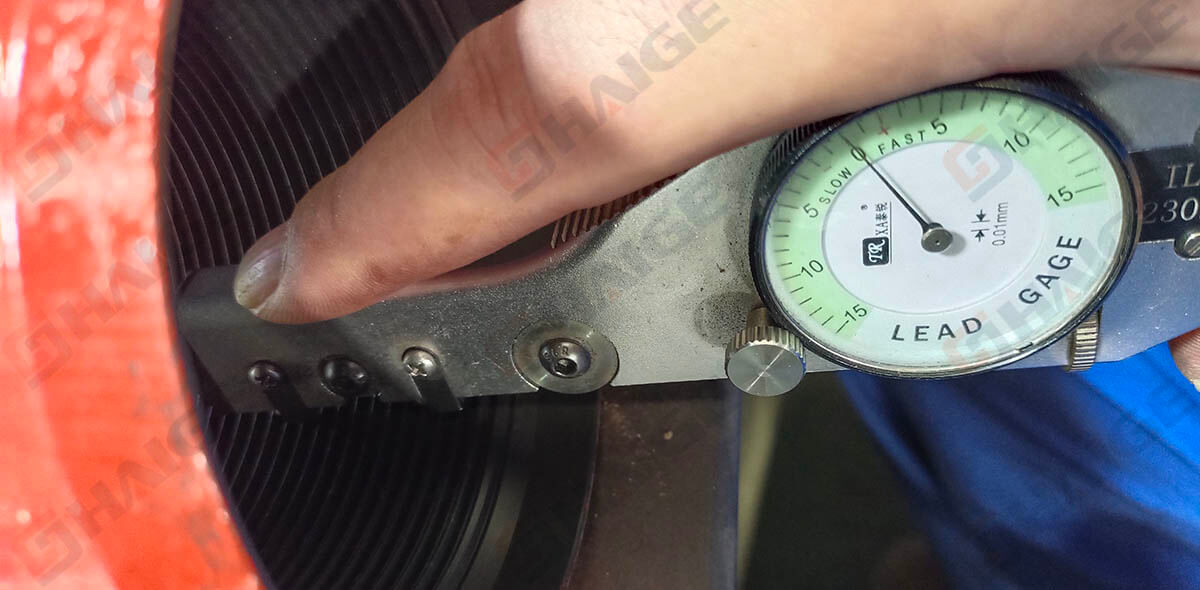
Use calibrated inspection equipment, such as calipers, micrometers, bore gauges, thread gauges, and other suitable measuring devices. Record actual measured values, inspection location, instrument identification, calibration status, acceptance criteria, and inspection result.
Measurement frequency must follow the governing API requirements, the approved inspection plan, and the purchaser’s requirements.
For API connections, establish the applicable threading and gauging requirements based on the current API Spec 5B and the specified connection type.
API identifies Spec 5B as the standard covering threading, gauging, and inspection of casing, tubing, and line-pipe threads.
6. Thread Gauging
Thread gauging verifies that the coupling’s threaded connection meets the required dimensional and functional criteria.
Typical inspection equipment may include:
- Working plug gauges
- Working ring gauges
- Thread gauges
- Calipers
- Micrometers
- Specialized API thread inspection equipment
Verify gauge calibration status before inspection.
Do not rely solely on visual thread inspection.
A thread may appear acceptable yet still have dimensional deviations that affect proper make-up or connection performance.
7. Surface and Machining Inspection
Inspect the coupling body and threaded area for machining defects.
Pay particular attention to Thread roots, Thread crests, Coupling ends, Machined surfaces, and transition areas.
Evaluate sharp edges, burrs, excessive tool marks, and surface defects according to the applicable specification.
8. Hardness Inspection
For L80 products, hardness is particularly important because the grade has controlled mechanical and material-property requirements.
Record:
- Hardness value
- Test method
- Test location
- Testing equipment
- Equipment calibration
- Applicable acceptance criteria
Trace hardness results to the specific product lot or heat. If hardness is outside the applicable acceptance range, identify it.
9. Non-Destructive Examination (NDE)
Where required by the applicable specification, purchase order, or supplementary requirements, perform the specified NDE.
Potential inspection methods can include:
Magnetic Particle Inspection — MT
Useful for detecting surface and near-surface discontinuities in suitable ferromagnetic materials.
Ultrasonic Testing — UT
Can detect certain internal or subsurface discontinuities, depending on the specified method and equipment.
Other NDE Methods
Other methods may be used where specified by the purchaser, applicable product requirements, or an approved inspection procedure.
API’s current 5CT program specifically addresses inspection and testing requirements, and API has highlighted changes concerning NDE personnel certification in its 5CT revisions.
10. Marking Inspection
Correct marking is essential for the identification and traceability of couplings.
Check that the required markings are correct, legible, and properly located.
Depending on the applicable requirements, markings may identify information such as: Manufacturer, Grade, Size, Product identification, Heat number, Applicable specification, Connection information.
11. Thread Compound and Storage Condition
Where applicable, inspect the condition of thread compound, storage coating, corrosion protection, thread cleanliness, packaging, and moisture protection.
Protect the thread from contamination, impact, and corrosion before installation.
The exact thread compound and application requirements must follow the applicable connection specification and purchaser requirements.
12. Documentation Review
A complete inspection should include document verification.
Depending on the purchase order, documentation may include:
- Material Test Certificate (MTC)
- Mill Test Report (MTR)
- Chemical analysis
- Mechanical test results
- Hardness results
- NDE reports
- Dimensional inspection report
- Thread inspection report
- Heat-treatment records
- Calibration certificates
- Certificate of Conformance
- Packing list
- Traceability records
The documentation must match the actual physical product.
API 5CT L80 Casing Coupling Inspection Checklist
| Inspection Item | What to Check | Status |
| Purchase Order | Size, grade, connection, quantity | ☐ Pass ☐ Fail |
| API Specification | Correct edition/revision | ☐ Pass ☐ Fail |
| Material Grade | L80 type verified | ☐ Pass ☐ Fail |
| Heat Number | Traceability confirmed | ☐ Pass ☐ Fail |
| Chemical Composition | Meets applicable requirements | ☐ Pass ☐ Fail |
| Mechanical Properties | Meets specified requirements | ☐ Pass ☐ Fail |
| Hardness | Tested where required | ☐ Pass ☐ Fail |
| Visual Inspection | No unacceptable defects | ☐ Pass ☐ Fail |
| OD | Within applicable tolerance | ☐ Pass ☐ Fail |
| ID / Wall | Within applicable requirements | ☐ Pass ☐ Fail |
| Length | Within applicable tolerance | ☐ Pass ☐ Fail |
| Thread Profile | Acceptable | ☐ Pass ☐ Fail |
| Thread Gauging | Gauge inspection passed | ☐ Pass ☐ Fail |
| Thread Condition | No unacceptable damage | ☐ Pass ☐ Fail |
| NDE | Completed where required | ☐ Pass ☐ Fail |
| Marking | Correct and legible | ☐ Pass ☐ Fail |
| Thread Protectors | Correct and undamaged | ☐ Pass ☐ Fail |
| Thread Compound | Correct condition/application | ☐ Pass ☐ Fail |
| MTC/MTR | Available and traceable | ☐ Pass ☐ Fail |
| NDE Reports | Complete where required | ☐ Pass ☐ Fail |
| Final Packaging | Suitable for transport/storage | ☐ Pass ☐ Fail |
| Final Release | All requirements satisfied | ☐ Pass ☐ Fail |
Common Problems Found During Casing Coupling Inspection
Several issues can cause a coupling to be rejected or demand further evaluation.
Thread Damage
Damaged threads can prevent proper make-up and may affect connection performance.
Incorrect Dimensions
An incorrect OD, length, or other critical dimension can cause incompatibility with the casing string.
Poor Surface Condition
Deep scratches, gouges, pits, cracks, or other unacceptable imperfections can compromise product quality.
Missing Traceability
If the heat number or other identification cannot be connected to the material documentation, the lot may require additional investigation.
Incorrect Marking
Incorrect grade, size, manufacturer identification, or other required markings can create serious traceability problems.
Incomplete Documentation
A physically acceptable product can still fail a contractual inspection if it lacks required certificates or inspection records.
Damaged Threads During Transportation
Even correctly manufactured couplings can be damaged after production if they are handled or transported improperly.
API 5CT 11th Edition: An Important Update for Buyers
Buyers should be careful when using inspection checklists based on older specifications, supplier documents, or previous purchase orders.
API Spec 5CT 11th Edition was published in December 2023. API subsequently published Addendum 1 in May 2025 and Errata 3 dated June 24, 2026.
These updates mean that purchase specifications and inspection checklists should identify not only the API standard number but also the applicable edition, addenda, errata, connection requirements, and purchaser-specific requirements.
API has also noted that the 11th Edition no longer uses the Product Specification Level terminology used in the 10th Edition.
Therefore, buyers should not copy acceptance criteria or terminology from older checklists without verifying their continued applicability to the governing order specification.https://www.api.org/products-and-services/standards/important-standards-announcements/spec5ct-tradepress
API 5CT L80 Casing Coupling Inspection: Best Practices
An effective inspection system should follow a documented sequence:
Purchase Order Review
↓
Material & Heat Traceability
↓
Chemical & Mechanical Verification
↓
Dimensional Inspection
↓
Thread Inspection & Gauging
↓
Visual Inspection
↓
Hardness / NDE Where Required
↓
Marking Verification
↓
Documentation Review
↓
Final Inspection
↓
Packaging & Thread Protection
↓
Release
This sequence helps manufacturers, suppliers, buyers, and third-party inspectors control the full chain of conformity and reduce the risk of releasing nonconforming casing couplings.
How to Choose an API 5CT L80 Casing Coupling Supplier
When purchasing L80 casing couplings, price should not be the only consideration.
Evaluate a potential supplier’s:
- API certification status, where applicable
- Manufacturing capability
- Material traceability
- Threading capability
- Thread-gauging procedures
- Heat-treatment controls
- NDE capability
- Inspection equipment
- Quality management system
- Documentation system
- Product traceability
- Packaging and thread protection
- Export experience
- Ability to support third-party inspection
A reliable supplier should be able to explain how it controls each coupling from raw material through final inspection, marking, documentation, packaging, and shipment.
Frequently Asked Questions
What should be checked on an L80 casing coupling?
Main inspection areas include material grade, heat traceability, dimensions, thread condition, thread gauging, visual condition, hardness, NDE where required, marking, thread protection, and documentation.
What API standard applies to L80 casing couplings?
API Spec 5CT covers technical delivery requirements for casing and related products, including couplings and coupling material. API Spec 5B addresses threading and gauging requirements.
Does API 5CT L80 include different L80 types?
Yes. API Spec 5CT 11th Edition recognizes L80 Type 1, L80 3Cr, L80 9Cr, and L80 13Cr. Buyers should state the exact L80 type on the purchase order rather than using “L80” alone, where the requirement may be ambiguous.
Is visual inspection enough for L80 casing couplings?
No. Visual inspection is only one part of a complete inspection program. Depending on the applicable specification and purchase requirements, you may also need dimensional inspection, thread gauging, material verification, hardness testing, NDE, and documentation review.
Why is thread gauging important?
Proper gauging verifies that the casing thread dimensions and geometry meet applicable requirements and support proper make-up.
Should an L80 casing coupling have a material certificate?
The required documentation depends on the applicable specification and purchase order. Buyers should establish documentation requirements before production and verify that certificates are traceable to the supplied material.
Can every L80 coupling be inspected using the same checklist?
No. The checklist must be adapted to the exact casing size, weight, L80 type, connection type, coupling type, governing standard edition, applicable addenda and errata, supplementary requirements, inspection level, and purchaser-approved ITP.
Can I use an old API 5CT inspection checklist?
An old checklist may contain outdated terminology or requirements. API 5CT 11th Edition introduced significant changes, including removing PSL terminology, and API has since issued an Addendum and additional errata. Always verify the checklist against the edition and revisions specified for the purchase.
Conclusion
Treat API 5CT L80 casing coupling inspection as a complete quality-control process, not a simple visual check.
A robust inspection program verifies:
Material → Traceability → Dimensions → Threads → Gauging → Surface → Hardness/NDE → Marking → Documentation → Packaging
By controlling each stage, manufacturers, suppliers, buyers, and third-party inspectors can reduce the risk of receiving nonconforming material, prevent thread-related installation issues, improve supplier accountability, and support reliable casing-string assembly.
Most importantly, inspection criteria should always be based on the applicable API 5CT edition and revisions, API 5B requirements for the connection, purchase order, and any agreed supplementary requirements.
Need API 5CT L80 Casing Couplings?
Haige Machinery supplies and stocks API 5CT casing couplings and tubing couplings for oil and gas applications, including J55, K55, N80, N80-Q, L80 Type 1, L80 3Cr, L80 9Cr, L80 13Cr, C110, P110, and Q125 requirements.
Our support includes:
- API 5CT casing couplings and tubing couplings.
- L80 Type 1, L80 3Cr, L80 9Cr, and L80 13Cr coupling requirements.
- Special Clearance Couplings
- OCTG accessories and related components.
- Material certificates and traceability documentation.
- Dimensional, thread-inspection, and gauging records where required.
- Third-party inspection coordination.
- Export packing and thread protection.
- Bulk orders and custom sourcing requirements.
Request a Quote for L80 Casing Couplings or other API 5CT Couplings?
Send us your casing size, weight, grade, connection type, quantity, and required API specification, and our team can help confirm the appropriate coupling specification and inspection requirements.
#API5CT #L80Casing #L80Couplings #CasingCouplings #CasingPipe #OCTG #OCTGProducts #API5CTCouplings #CasingInspection #CouplingInspection #OilfieldEquipment #OilfieldProducts #OilAndGas #DrillingEquipment #WellCompletion #CasingAndTubing #APIStandards #OCTGInspection #OilfieldSupply #CasingCouplingSupplier
References
1. API SPEC 5B – Specification for Threading, Gauging, and Thread Inspection of Casing, Tubing, and Line Pipe Threads. API SPEC 5B. https://standards.globalspec.com/std/1091134/api-spec-5b
2. https://www.apiwebstore.org/standards/5B
3. https://www.api.org/products-and-services/standards/addenda-and-errata