
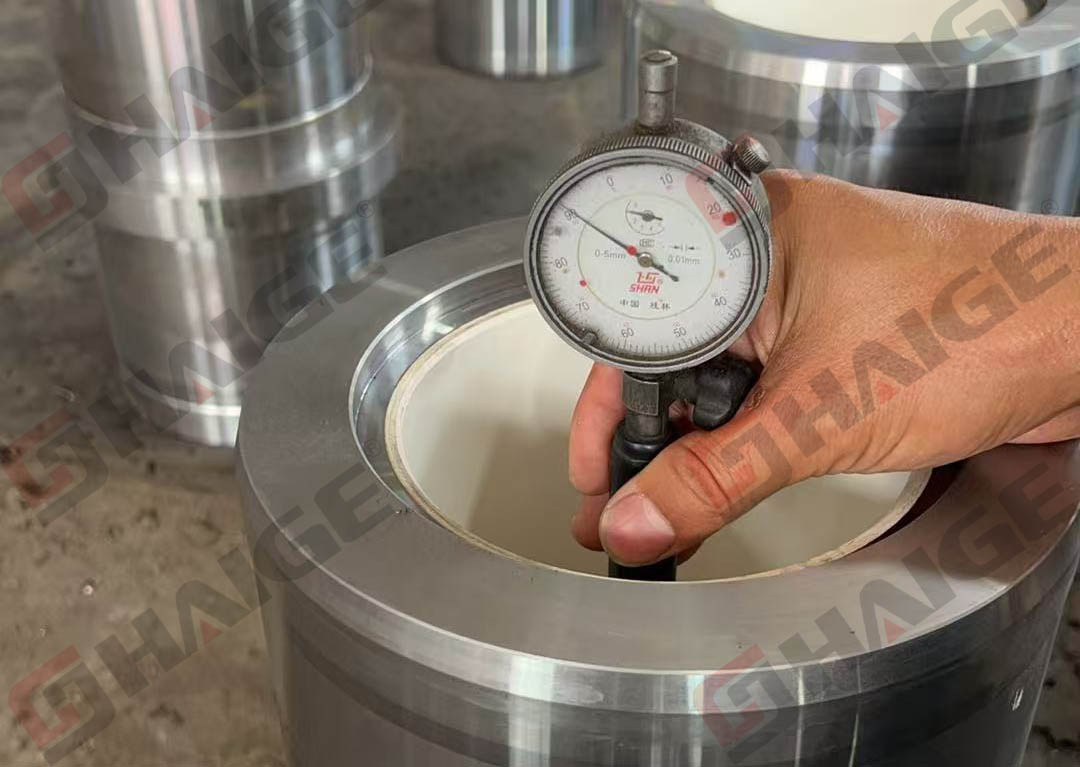
A liner that fails on a rig doesn’t just mean a new part. It also costs hours of non-productive time. It can damage the piston. It may score the module bore. It can also hurt the customer’s confidence. That’s why the inspection routine behind a finished liner matters as much as the metallurgy. Below is the qualification path we apply to every liner we ship, from the bar stock and ceramic blanks to the crate.
Step 1 — Confirming the raw material & chemical composition
Inspection starts before anyone turns a chuck. Each incoming batch of forging stock has a mill certificate. We also re-verify it ourselves rather than accepting the paperwork at face value.
- Spectro/PMI readings on the steel hull to confirm the alloy grade for the outer sleeve. Land high-chrome white iron for the inner sleeve on bimetal designs.
- Heat-lot traceability logged against a serial that follows the liner through every later step.
Step 2 — Dimensional and geometric verification
The piston-liner pair only seals when the bore geometry is honest. We measure each liner — not a sample on these points: Inner Bore Diameters, Outer Diameters, and Overall Length.
| Inner bore diameter | +0.05~0.10 mm of nominal |
| Cylindricity along the full bore | within 0.03 mm |
| Coaxiality bore to OD | within 0.10 mm |
| Overall length | ±0.20 mm |
Step 3 — Hardness Test
Haige performs Rockwell (HRC) testing for steel sleeves and Rockwell A (HRA) testing for ceramic sleeves.
- For Bi-Metal High Chrome Liners, the inner working surface to land between HRC 60 and HRC 65
- For Zirconia Ceramic Liners, the zirconia working surface hardness exceeds HRA 90.
Step 4 — Bore surface finish
The bore surface must be sufficiently smooth to preserve the life of the piston rubber.
Roughness is measured with a stylus profilometer, targeting an Ra of 0.4 to 0.8 µm over the working length.
Step 5 — Visual Inspections
Once the liner is machined, we perform a visual inspection under raking light for chatter marks, honing scratches, chips on the ceramic ends, and any contamination in the bore.
Step 6 — Matching, marking, and the paperwork the buyer actually keeps
These sound like the boring-but-critical details:
- Permanent marking— size, heat number, serial, and our mark, stamped where it won’t be hidden by the retainer.
- Documentation package— material certs, dimensional report, hardness, and a certificate of conformance referencing API 7K and any customer-specific spec.
The customer or user who receives the goods can re-check the liner on arrival. If they have a problem within a year, they can trace it back to the heat. These matter more than most catalogs admit.
What Means When You Order From Us
Every liner that leaves our shop has been fully inspected. No shortcuts. No skipped paperwork. If a liner doesn’t pass, it doesn’t ship —regardless of lead-time pressure.
This process applies to our full liner range. It includes bimetal high-chrome liners and zirconia ceramic liners.
These liners fit all major pump models, including EMSCO, Gardner Denver, NOV, National, Oilwell, IDECO, Wirth, and BOMCO.
Ready to Source Liners That Pass Before They Ship?
Tell us your pump model, liner size, and required quantity. Our team will confirm availability, provide material certifications, and send a quotation — typically within 24 hours.
Request a Quote Now — include your pump model and liner bore size for a faster response.
Prefer email? Send your inquiry directly to info@haigemachinery.com with your liner spec or drawing reference.
#MudPumpLiners #OilfieldEquipment #API7K #QualityControl #DrillingEquipment
#OilfieldSupplies #EngineeringStandards #RigReliability #MudPumpLinersinepction
#relibaleMudPumpParts #MudPumpLinersqualitycontrol