
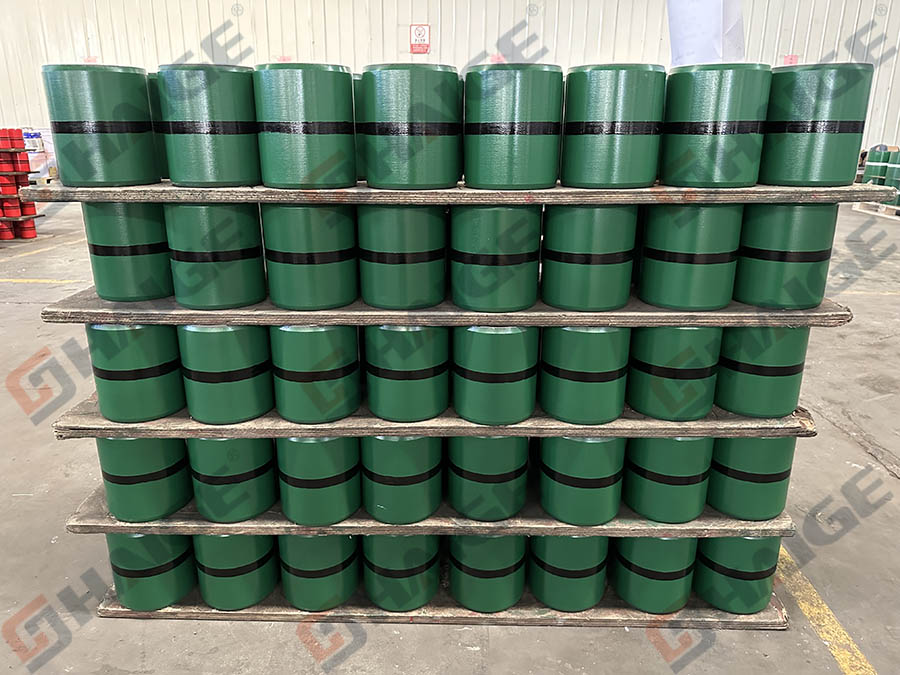
Operators rarely lose time because of the pipe body. Most NPT stems from the connection. This article helps you choose API 5CT casing couplings and tubing couplings with confidence to keep strings gas-tight and stay on schedule.
What Problem Do Couplings Actually Solve in a Well?
Couplings create a sealed, load-bearing joint between two tubulars. In casing, they carry tension, compression, and pressure while surviving handling abuse. In tubing, they endure frequent pressure/temperature swings, as well as flow-induced vibration. A correctly specified coupling avoids leaks, galling, cross-threading, and premature fatigue—common triggers of non-productive time.
API or Premium—How Do I Choose the Right Connection?
Start with your risk profile and operating envelope.
- API 8-Round (STC/LTC):Proven, economical seal for moderate pressures and conventional wells.
- API Buttress (BTC):Higher tensile capacity, robust make-up window; standard for deeper casing strings.
- Premium:Metal-to-metal seals and torque shoulders provide gas-tight They are suitable for HP/HT, deviated ERD wells, and severe cycling.
Tips: If you require gas-tight integrity, anticipate high dogleg severity, or expect thermal cycling (such as steam injection or HP/HT), premium couplings are the safer option.
Which Grades and Sizes Cover Most Jobs?
- Casing Couplings:J55/K55 for shallow; N80/L80 for moderate depth/temperature; P110/Q125 for high loads; CRA (13Cr and beyond) for corrosive service. Standard nominal sizes range from 4½″ to 20″.
- Tubing Couplings:2⅜″–4½″, typically in J55, N80, L80 Type 1/13Cr, and P110. Gas lift and corrosive service often push toward 13Cr or specialty alloys.
Always confirm drift and coupling OD against centralizers, restrictions, and completion accessories.
Why Do Threads Gall or Leak—and How Can I Prevent It?
Root causes include:
- Dirty threads
- Wrong compounds
- Gauges that are out of tolerance
- Incorrect torque
- Damage to protectors during storage
Prevention checklist:
- Verify API 5Bgauging
- Keep protectors on until you make up; clean and dry threads immediately afterward.
- Use the correct compound and follow the torque window.
- Record torque-turndata and stop if complex make-up is detected.
Can I Mix Thread Forms Between Casing and Tubing?
Direct mixing is not acceptable. Use engineered crossovers designed for the exact thread pair. Confirm drift, seal geometry, make-up loss, and OD clearance at the transition.
What Coatings and Finishes Actually Help in the Field?
- Phosphate, copper, or zincfinishes reduce galling and facilitate reassembly.
- External varnishimproves storage life; internal coatings can reduce corrosion in humid or marine environments.
Choose finishes to match your fluids (CO₂/H₂S), storage conditions, and handling plan.
What’s Different About Tubing Couplings vs. Casing Couplings?
- Tubing sees cycles.Frequent start/stop cycles and temperature fluctuations require seal reliability and galling resistance.
- More handling and interventions.Tubing is pulled and re-run during workovers and interventions. Choose finishes that can withstand repeated make-and-break operations without damage.
- Gas and high-integrity service.Tubing more often requires premium, gas-tight thread profiles—especially for gas wells or wells with high pressure. Always check the OEM torque specifications. Watch the torque-turn during assembly. Follow the manufacturer’s guidelines for reuse and remanufacture.
How Do I Size the Budget Without Sacrificing Integrity?
- Use the APIwhere the risk is modest and pressure containment is well understood.
- Upgrade to premiumonly where the load case warrants it; don’t over-spec the entire string.
- Reduce landed cost with freight consolidation, well-by-well kitting, and on-hand inventoryfor standard sizes.
What Does a Reliable Supplier Add Beyond Inventory?
- Fit-for-purpose pairingof pipe grade, thread, finish, and torque window across your entire string.
- Inspection&QA(visual, dimensional, and profile) with documented gauges/calibration.
- Run support:torque-turn guidance, rejection criteria, and quick replacements.
- Traceability:heat numbers, MTRs, API monogram
- Logistics:aligned to your spud date with kitting, labeling, and sea-fastening-ready packaging where needed.
Quick Spec Guide (At a Glance)
- API 5CT Casing Coupling:8-Round (STC/LTC) or BTC; grades J55/K55/N80/L80/P110/Q125; phosphate or copper finish; verify OD vs. clearance.
- Tubing Couplings:8-Round or premium gas-tight; 2⅜″–4½″; J55/N80/L80 (Type 1/13Cr)/P110; dopeless optional; focus on galling resistance and cycle life.
FAQ
Q: Do I need a premium for sour service?
A: Often, yes—especially when you require gas-tight integrity and cyclic loads. Pair with 13Cr or CRA for corrosion demands.
Q: What’s the ideal torque?
A: Follow the OEM/API torque window for the exact connection; record torque-turn and stop if you see hard make-up.
Q: How should I store couplings?
A: Dry, covered, in room and out of salt spray.
#OCTG Couplings #CasingCoupling #TubingCoupling #OCTGInspection #API5CT #OilfieldServices #OilandGas #EnergyIndustry #DownholeTools